Office politics.
Playable consequences.
Colleagues and I imagined a corporate game years before the current AI wave. I revisited it to see what I could make playable in a few hours—starting with a card game, then exploring Hostile Takeover.
Read the case study
Your career. Their priorities.



It began as an idea between colleagues.
A few years ago, before the current wave of AI tools, some colleagues and I imagined a game about corporate life. Deadlines, meetings and office politics were material to play with. I returned to that idea with a challenge: how far could I take it in a few hours?
- The first experiment
- I started with the card game. Work advances a project, Blockers stop it and Capacity pays for actions. Familiar office situations became rules I could try.
- The exploration
- I worked through mechanics, game references and playable iterations. This was exploration through making; I did not begin with formal user research.
- The next direction
- After the card game, I explored the same premise as a corporate game in a League of Legends-style format: Hostile Takeover.

Both effects · one card
Read full rules
Ship It, Flag It
Add 3 Work to your selected project; Add 1 Blocker to each selected rival project. Work clears Blockers first and stops at project capacity.
Delivery includes a complimentary concern.
A correct result is not enough. Players need to follow it.
Early iterations could resolve a move correctly while making its effect hard to follow. The board was dense, effects arrived quickly and controls competed for attention. I reorganized play around a short sequence: choose, inspect, commit, then read the consequence.
- Keep the board stable
- Projects move through Scope, Build, Review and Ready. The hand, remaining Capacity and turn controls retain their places while targeting.
- Make time visible
- Players spend a sprint’s Capacity one action at a time, then choose Done. What remains can support protection.
- Let people catch up
- Practice can pause while inspection stays available. Reduced motion retains the information carried by an effect.
The actual paused practice build. Project stages, remaining Capacity and the hand stay visible together.
One card has to work at two reading distances.
A card in a hand needs to be recognized quickly. The same card in an inspector needs enough room to explain its complete behavior. With 390 card definitions and sixteen Heroes, the answer could not be a unique layout for every object.
- Recognize at a glance
- Keep the physical proportion, cost, illustration and key effect in consistent places across hand, collection and inspection.
- Read in depth
- Give full rules their own space. Longer descriptions should not force every card to become smaller.
- Keep the identity
- Contemporary office settings, recognizable props and restrained department accents connect the artwork. Type stays separate from the generated image.
Search and filter the collection without changing how a card is recognized.
Collecting should add delight, not gate the game.
As I developed the card game, I explored how packs could make collecting enjoyable while keeping the game accessible. I separated the playable pool from the collectible experience and kept the same pack object recognizable throughout.
- Access
- Equal Access makes the game pool available without first completing a collection. Cosmetics remain a separate layer.
- Consistency
- Seven pack products use fourteen covers. Gallery, inspector, unopened pack and reveal share the same visual language.
- Trust
- Contents are committed before the reveal. Reconnecting returns to that opening instead of producing another roll.
FYFiscal YearCollectible office mailProgress Pack5 cards · Set 01FYOpen · Five possibilitiesProgress Pack
Cards with primary Progress role.
Five cards. Exact odds.
- Slots 1–3
- Common · 100% each
- Slot 4
- Rare · 100%
- Slot 5
- Common 70% · Rare 27% · Ultra Rare 3%
All seven pack types share one guarantee. After 24 openings without an Ultra Rare, the next pack’s fifth slot is Ultra Rare. Any Ultra Rare resets the counter.
Each slot also has a separate 5% cosmetic foil chance. Specialized pools change the eligible cards, not the rarity odds.
How much could I make playable in a few hours?
That question set the pace of the first experiment. I used Codex to build and try the card-game idea, then kept refining it. I directed the rules, interactions and artwork, using each playable iteration to decide what needed attention next.
- Make a first loop
- Turn the premise into rules, a board and actions I could try. Playing through a turn gave me something concrete to inspect.
- Inspect the result
- I reviewed cards in the hand, packs during opening and characters in the actual interface. Later iterations developed the broader game shown here.
- Protect continuity
- As the project grew, versioned rules, art manifests and implementation checks kept changes traceable and protected existing matches and pack contents.
A retained implementation check of the real pack component. Its proportions and identity carry through the reveal.
Then I tried the idea in a different format.
After the card game, I began Hostile Takeover: a corporate take on League of Legends-style team combat, with Warcraft III’s hero-and-army control as another reference. The same office satire became an isometric battlefield. I developed two modes and a playable local prototype to explore that direction.
- Team combat
- In 5v5 Hostile Takeover, each player controls a Champion, fights alongside automated squads and works toward the rival headquarters.
- An operating economy
- In 2v2 Corporate War, workers gather Budget and Data, build departments and support an army alongside the Champion.
- A shared foundation
- Both modes use the same office, combat and progression systems, while asking players to manage different kinds of attention.
Orientation practice in the actual local prototype. The live environment and characters use procedural 3D geometry.
Control one Champion. Push with your team and automated squads, break rival security and reach the opposing headquarters.
Make a role recognizable before the first ability is cast.
The fourteen-Champion roster connects office identity to a fantasy role. A designer becomes a Dwarf Warrior with a Query Hammer; an engineering Paladin protects the team with Type Safety. Names, equipment, silhouettes and ability kits work together to make the cast memorable.
- Character
- The Fellowship and C-suite turn familiar workplace relationships into distinct playable identities.
- Behavior
- Named Q, W, E and R abilities give each Champion a kit. XP, skill choices and equipment continue that identity during play.
- Art direction
- Original full-body renders establish the intended character treatment. They are kept distinct from the procedural models in the playable build.
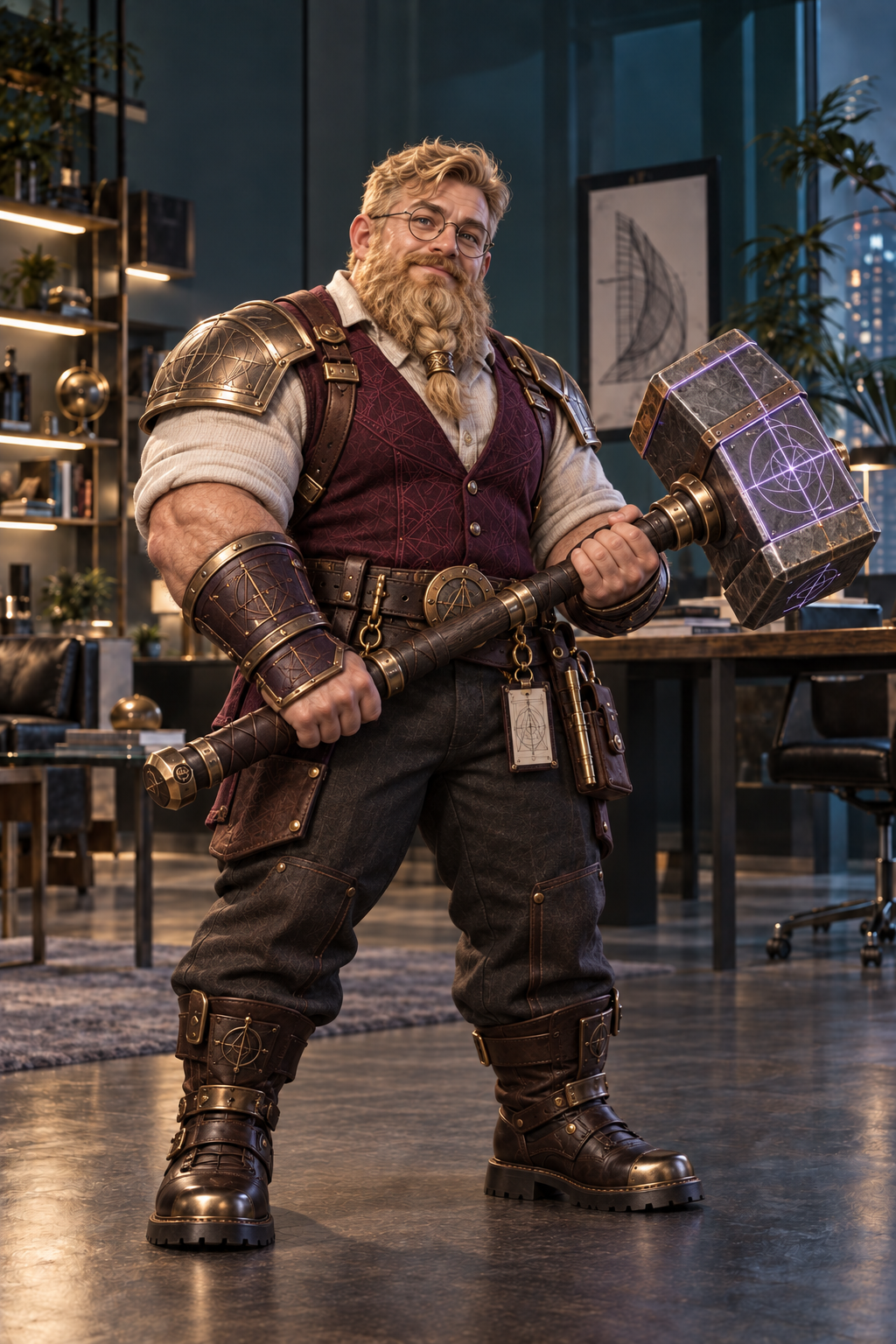
Xim
Dwarf · Warrior
Design
- Signature equipment
- Query Hammer
Slam your hammer into the nearby floor. A single shockwave damages and slows rivals within the impact area.
Original character renders and source-defined abilities. The live game uses simpler procedural models.
Turn the office into a place worth discovering.
Meeting rooms, workstations, server areas and headquarters become tactical spaces. Two connected floors give players somewhere to explore, while fog and discovery control how much information they have. The challenge is helping someone understand both where they are and what they can do there.
- Orientation
- The world map, minimap, camera follow and floor transitions support movement across the connected office.
- Office mechanics
- A Mandatory Meeting becomes a trap that stops movement and casting; destroying it releases the target. In Corporate War, occupied rooms defend themselves and generate Budget.
- Readable consequences
- Targeting, pursuit, attacks, equipment changes and level progression need visible feedback. Confirmed combat events drive the effects.
The office build connects two floors by elevator, with discovery tracked separately on each floor.
A playable world, and a clearer standard for what comes next.
Fiscal Year became a local card-game product with practice, private rooms, characters, decks, collection, packs and replays. Hostile Takeover became a separate playable office prototype with both main modes and Orientation practice. These are implementation outcomes, not evidence of launch or player adoption.
- What I checked
- Rules and server behavior, a complete six-sprint practice match, layout, recovery, keyboard interaction, enlarged text and reduced motion.
- What remains open
- Human playtesting, game balance and public operation. Hostile Takeover also needs its finished character pipeline and crowded-fight performance work.
- What I learned
- A rule only becomes part of the experience when someone can understand it, act on it and follow its consequence. That standard applies to the cards, the economy and the office battlefield.
The local card game includes practice, private rooms, decks, collection, packs and replays. Public hosting and checkout remain outside the delivered scope.